


La thérapie par contraste pour le visage : ce que l'alternance chaud-froid fait vraiment pour la peau
La thérapie par contraste alterne le chaud et le froid pour offrir à la peau un doux « entraînement vasculaire ». Voici comment cette technique de spa agit réellement sur votre visage, le bon ordre entre le chaud et le froid, et comment la pratiquer...
La thérapie par contraste consiste à alterner le chaud et le froid sur la peau pour soutenir l'apparence et la sensation d'une bonne circulation. Les athlètes l'utilisent depuis des décennies, avec les bains de glace et les cycles de sauna. Sur le visage, le même principe prend aujourd'hui la forme d'une vapeur chaude suivie d'un froid contrôlé, et il devient rapidement l'un des rituels maison les plus en vogue en soins de la peau.

Qu'est-ce que la thérapie par contraste?
La thérapie par contraste, parfois appelée thérapie chaud-froid, consiste à faire passer la peau d'une température chaude à une température froide selon une séquence délibérée, plutôt que de choisir l'une ou l'autre. Le concept vient de la récupération sportive, où les athlètes alternent l'immersion en eau chaude et en eau froide pour aider leurs muscles à se sentir moins fatigués après un entraînement intense. La culture nordique du bain a bâti tout un rituel autour de la même idée : le sauna, puis une immersion dans l'eau froide, répétés en cycles.
Le visage est la nouvelle frontière de cette pratique. Les esthéticiennes utilisent depuis longtemps des soins « feu et glace » qui associent des serviettes chaudes ou de la vapeur à une finition froide. Ce qui a changé, c'est l'accès. Un rituel qui exigeait autrefois un rendez-vous au spa peut maintenant se faire au lavabo de la salle de bain en dix minutes.
Comment la thérapie par contraste agit-elle sur la peau du visage?
Le mécanisme est simple. La chaleur provoque la dilatation des vaisseaux sanguins proches de la surface de la peau, un processus appelé vasodilatation. Le froid fait l'inverse : il provoque le rétrécissement de ces mêmes vaisseaux, ce qu'on appelle la vasoconstriction. Alterner entre les deux crée ce que beaucoup décrivent comme un « entraînement vasculaire », un mouvement doux de va-et-vient que la peau ne connaît pas avec une température unique et constante.
En termes simples : la chaleur ouvre, le froid resserre, et c'est dans la transition entre les deux que les gens disent ressentir l'effet le plus immédiat, autant dans la sensation que dans l'apparence visible de leur peau.
Quels sont les bienfaits de la thérapie par contraste pour le visage?
Voici les effets les plus souvent rapportés et observés avec un rituel facial du chaud au froid. Comme pour toute routine cosmétique, les résultats varient selon le type de peau et la régularité d'utilisation.
- Des pores d'apparence affinée. La chaleur permet aux pores de se relâcher et de libérer plus facilement les impuretés de surface, tandis que la finition froide aide la peau à paraître visiblement plus ferme et plus lisse immédiatement après.
- Un aspect moins bouffi. La phase froide, en particulier, contribue à dégonfler visiblement le visage, surtout au réveil.
- Un teint plus lumineux et plus éveillé. Beaucoup de gens remarquent une différence d'éclat immédiate juste après une séance, probablement liée au changement de température lui-même.
- Une meilleure absorption des produits après la vapeur. Une peau chaude et assouplie accepte généralement plus facilement les sérums et les hydratants qu'une peau sèche et fermée.
- Un rituel réellement relaxant. Au-delà de la peau, l'expérience sensorielle, la chaleur qui laisse place à une finition fraîche, est l'un des rituels de deux minutes les plus apaisants d'une routine de soins.
Le chaud ou le froid en premier? Le bon ordre
La séquence compte. Commencez par la vapeur chaude pour assouplir la peau et déloger le sébum et les impuretés de surface, généralement pendant cinq à huit minutes. Terminez par un froid contrôlé, autour de 1 à 4°C, maintenu pendant une à deux minutes. C'est la finition froide qui produit l'effet visiblement raffermi et dégonflé que la plupart des gens recherchent. Terminer par la chaleur laisse la peau rougie et les pores plus ouverts, soit l'inverse de l'effet que veulent la plupart des adeptes de la thérapie par contraste.
Comment faire de la thérapie par contraste à la maison?
Il existe trois approches courantes, par ordre de constance et de contrôle.
La version maison avec une serviette chaude et un bol de glace. C'est le point de départ le plus accessible : une serviette chaude et humide appliquée sur le visage pendant plusieurs minutes, suivie d'un bol d'eau glacée pour une éclaboussure froide ou une brève immersion. Ça fonctionne, mais la température de l'eau varie rapidement, et la glace brute contre la peau peut agir de façon inégale et, pour certains, être inconfortable.
Un soin « feu et glace » au spa. Les esthéticiennes proposent cette association depuis des années, généralement comme étape de finition ajoutée à un soin du visage complet.
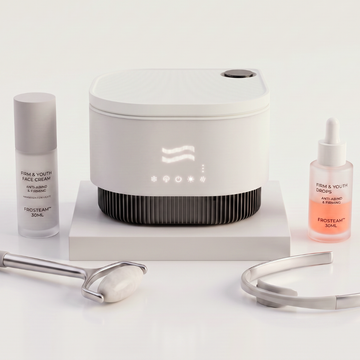
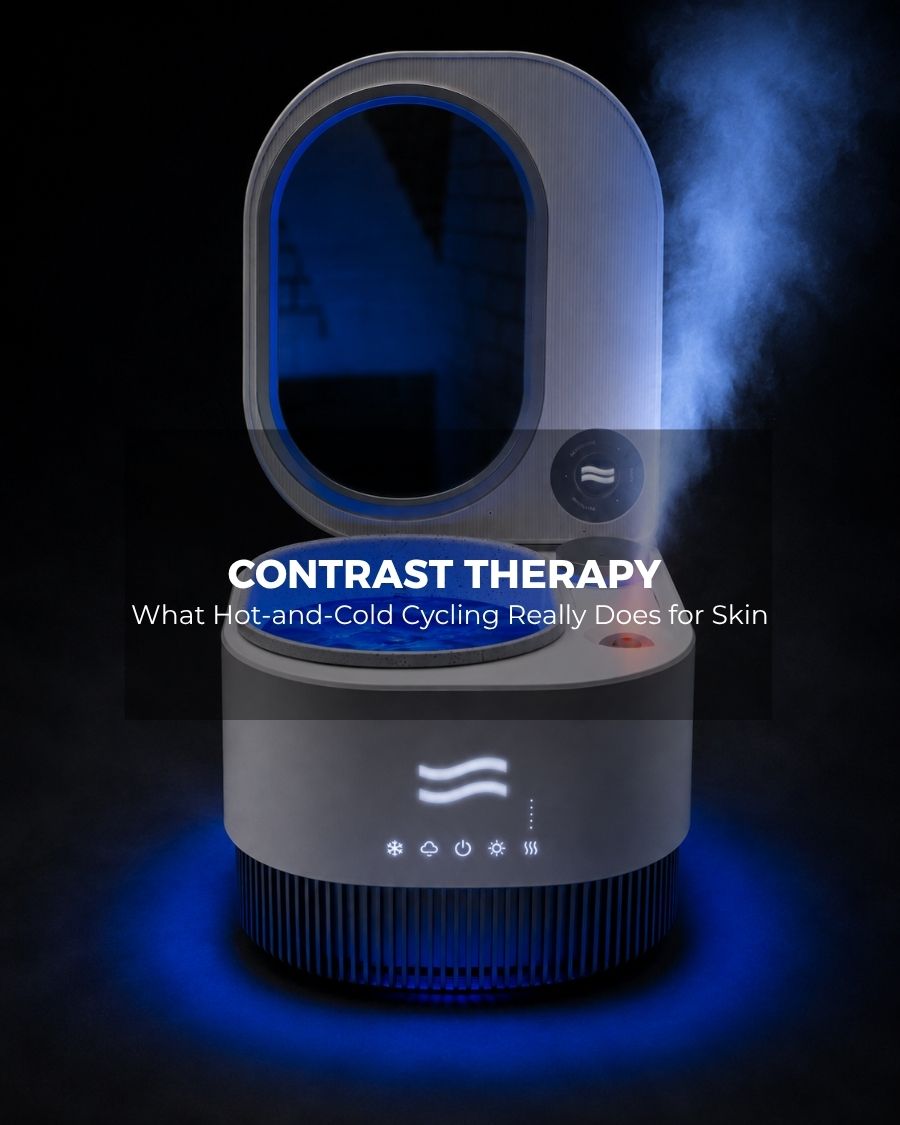
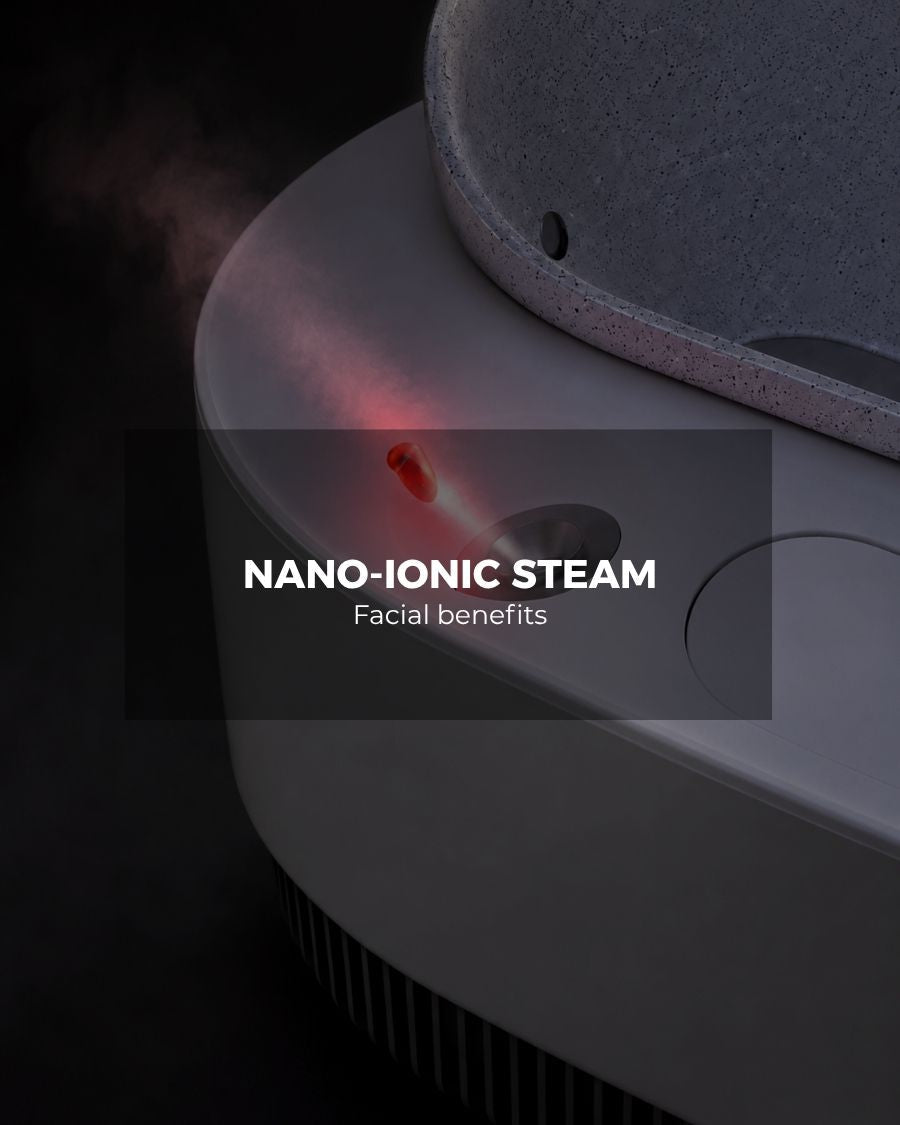
Un appareil dédié. C'est là qu'un appareil 3-en-1 qui automatise le cycle chaud-froid change l'expérience. Au lieu de gérer une bouilloire d'eau chaude et un bol de glace qui fond, Harmony automatise le cycle : la vapeur nano-ionique (voir son fonctionnement) pour la phase chaude, suivie d'un bassin d’eau glacée contrôlé entre 1 et 4 °C grâce au système Thermo-Cooling de Frosteam pour la finition froide, avec une chambre d'aromathérapie en option. La température reste constante pendant toute la séance, et c'est l'élément le plus difficile à reproduire à la main. Harmony est actuellement offert : procurez-vous le vôtre dès maintenant en précommande.
La thérapie par contraste convient-elle à votre type de peau?
Pour la plupart des gens, oui, avec modération. Quelques points sont bons à savoir avant de commencer :
- Les peaux sensibles ou sujettes à la rosacée devraient commencer par une exposition au froid plus courte et une phase de vapeur tiède (pas chaude), car les variations brusques de température peuvent provoquer des rougeurs sur une peau réactive.
- Le froid contrôlé vaut mieux que la glace brute. Une température constante de 1 à 4°C offre une expérience plus douce et plus prévisible qu'un glaçon qui commence au point de congélation et se réchauffe de façon inégale contre la peau.
- La régularité plutôt que l'intensité. Des séances plus courtes et plus fréquentes sont généralement mieux ressenties par la peau qu'un long cycle intense.
Si vous avez une affection cutanée active, êtes enceinte ou avez un problème cardiovasculaire, consultez un médecin avant de commencer toute routine d'exposition au froid, pour le visage ou autre.

Laisser un commentaire
Ce site est protégé par hCaptcha, et la Politique de confidentialité et les Conditions de service de hCaptcha s’appliquent.