
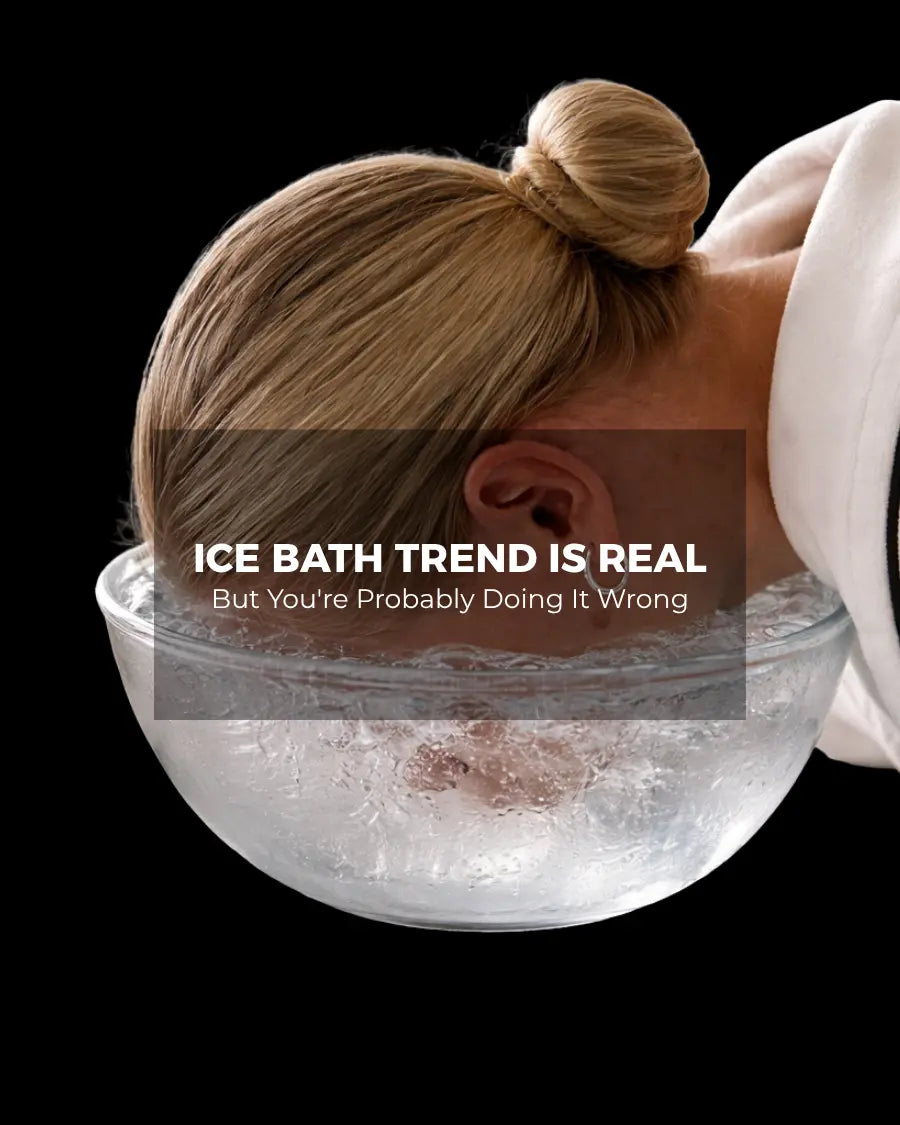
La tendance du bain de glace pour le visage est réelle — mais vous le faites probablement mal
Vous l'avez vu partout. Des influenceurs qui plongent leur visage dans des bols d'eau glacée. Des célébrités qui attribuent l'éclat de leur peau avant un événement à un bain de glace pour le visage. Hailey Bieber. Kylie Jenner. Des millions de vues sur TikTok. La tendance du soin du visage à la glace a explosé en 2026 pour une raison : les résultats sont immédiats, visibles et étayés par une physiologie réelle. Mais voici ce que ces vidéos virales ne vous montrent pas : le froid seul n'est que la moitié de l'équation. Et si vous sautez l'autre moitié, vous passez à côté des meilleurs résultats.
Pourquoi le bain de glace pour le visage fonctionne-t-il vraiment ?
La science derrière le soin du visage à la glace est simple et bien documentée. Lorsque le froid est appliqué sur le visage, les vaisseaux sanguins se contractent par un processus appelé vasoconstriction. Cela réduit le gonflement, draine l'excès de liquide via le système lymphatique et resserre temporairement la surface de la peau (Mooventhan & Nivethitha, 2014). Le résultat que la plupart des gens remarquent immédiatement : une réduction des poches, des pores d'apparence plus petite et un teint plus lumineux et plus uniforme en quelques minutes.
Le plongeon du visage dans la glace a également une dimension liée au système nerveux qui est rarement abordée. Plonger le visage dans l'eau froide active le réflexe de plongée des mammifères, une réponse physiologique innée qui ralentit le rythme cardiaque et place le corps dans un état plus calme et plus régulé (Goedeke et al., 2021). C'est pourquoi tant de personnes déclarent non seulement être plus belles après un soin du visage à la glace, mais aussi se sentir mieux. Plus calmes. Plus présentes. Ce n'est pas un placebo, c'est une activation parasympathique.
Le problème avec la glace directement sur votre peau
La version virale du bain de glace pour le visage — des glaçons dans un bol, le visage submergé — fait le travail de manière brute et incontrôlée. Les dermatologues signalent constamment les mêmes problèmes liés au contact direct avec la glace : une distribution inégale de la température, un risque de capillaires brisés en cas d'utilisation répétée et une irritation potentielle pour les personnes ayant une peau sensible ou de la rosacée (Westlake Dermatology, 2026).
Plus important encore, la glace dans un bol délivre le froid sans aucune préparation. Vous appliquez un froid intense sur une peau sèche, non hydratée et à température de base, ce qui signifie que les bienfaits sont réels mais superficiels, et l'absorption de tout produit de soin ultérieur est limitée. Vous obtenez l'effet visuel. Vous n'obtenez pas le réinitialisation physiologique complète.
Ce qui manque à un bain de glace pour le visage : l'étape de la chaleur
La thérapie par contraste, l'alternance délibérée entre le chaud et le froid, est là où se trouvent les vrais résultats. Ce n'est pas un concept nouveau. Elle est utilisée dans la culture balnéaire scandinave, la physiothérapie et la récupération sportive depuis des décennies. Le mécanisme : la chaleur ouvre, le froid scelle. La chaleur augmente le flux sanguin et la perméabilité de la peau, permettant une hydratation plus profonde et une meilleure absorption des produits. Le froid scelle ensuite le tout, réduit l'inflammation et tonifie la surface (Bieuzen et al., 2013).
Lorsque vous faites un plongeon du visage dans la glace sans phase de chaleur préalable, vous scellez une peau qui n'a jamais été ouverte. Vous obtenez l'effet dégonflant. Vous obtenez l'éclat. Mais vous manquez la fenêtre d'absorption, la période de 3 à 5 minutes après la vapeur où votre peau est la plus réceptive à tout ce que vous y appliquez. Un sérum appliqué sur une peau préparée à la vapeur s'absorbe à un niveau fondamentalement différent de celui appliqué à froid (Akomeah et al., 2004).
Pour une analyse complète de la façon dont la thérapie par contraste affecte le système nerveux au-delà de la peau, lisez Comment la thérapie par contraste aide à réguler le système nerveux.
Le protocole complet du bain de glace pour le visage : vapeur d'abord, froid ensuite
La routine de bain de glace pour le visage la plus efficace n'est pas seulement froide, elle est contrastée. Voici à quoi ressemble la séquence complète lorsqu'elle est effectuée correctement :
- Vaporisation pendant 3 à 5 minutes — la vapeur nano-ionique hydrate au niveau cellulaire, augmente la température de la peau et maximise la perméabilité pour l'absorption des produits
- Appliquez immédiatement les sérums et les actifs — la fenêtre d'absorption est ouverte ; c'est le moment où vos soins de la peau agissent réellement
- Thérapie par le froid pendant 1 à 2 minutes — la vasoconstriction scelle la peau, réduit les poches, raffermit la surface et fixe tout ce qui a été appliqué à l'étape 2
- Terminez avec une crème hydratante et un FPS — sur une peau entièrement préparée et régulée
La différence entre cela et un bol d'eau glacée ? L'un est une astuce. L'autre est un système.
Pourquoi la précision est plus importante que l'intensité
Une chose que la tendance du soin du visage à la glace ne comprend pas, c'est que plus froid = mieux. Ce n'est pas le cas. Le froid extrême, surtout de la glace brute, peut choquer la peau, causer des dommages capillaires en cas d'utilisation répétée et déclencher une réponse inflammatoire de rebond. La plage de température optimale pour la thérapie faciale par le froid est de 1 à 4 °C : suffisamment froide pour activer la vasoconstriction et le réflexe de plongée, suffisamment contrôlée pour éviter le stress tissulaire.
C'est la différence entre un outil physiologique et un défi viral. La précision l'emporte toujours sur l'intensité.
Pour comprendre comment la tendance du bain de glace pour le visage se compare au glaçage du visage avec des glaçons ou des rouleaux, lisez Glaçage du visage vs. Plongeon du visage : quelle tendance de thérapie par le froid est la meilleure pour votre peau.
Le bain de glace facial plus intelligent — intégré dans un seul appareil
Le défi de la thérapie par contraste à domicile a toujours été l'installation. Un appareil à vapeur faciale dans une main, un bol d'eau glacée dans l'autre, des huiles essentielles quelque part entre les deux. Ce n'est pas un rituel, c'est une production.
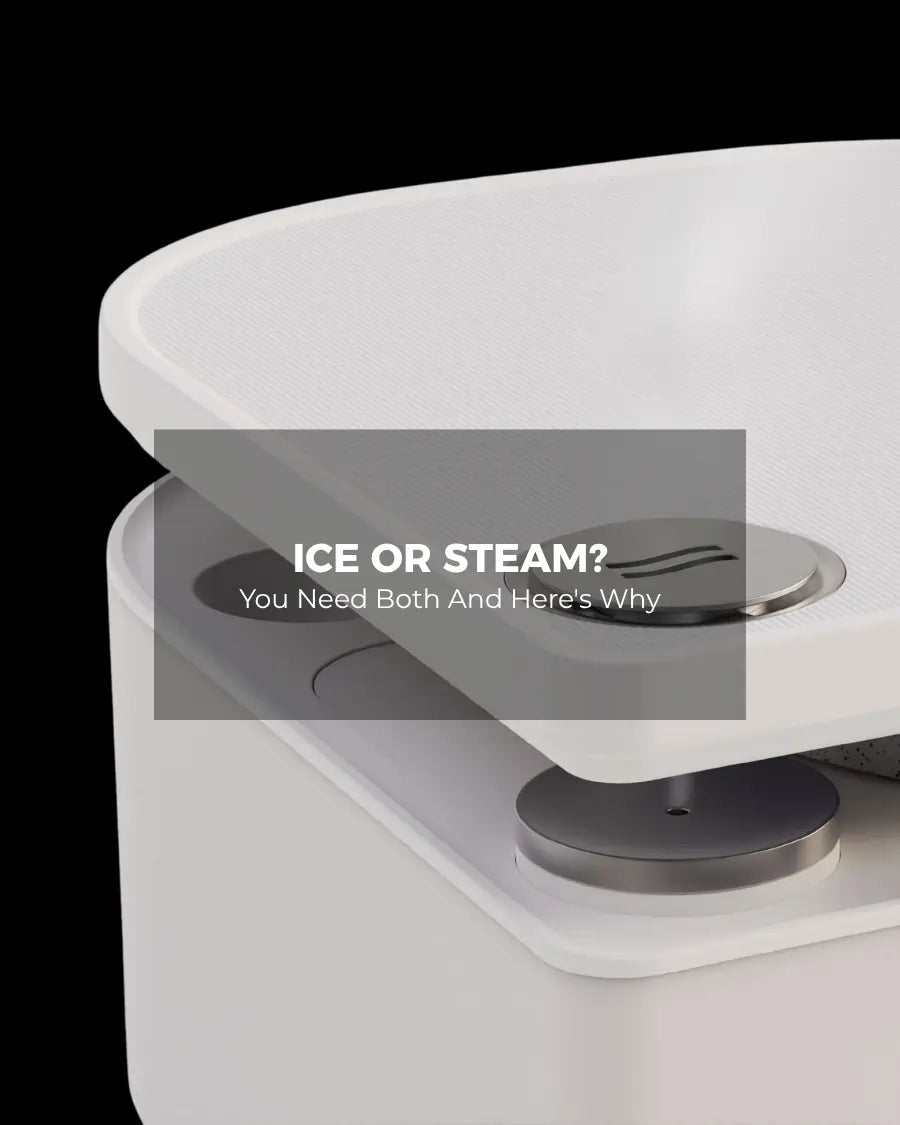
Frosteam a été conçu précisément pour résoudre ce problème. En tant que premier appareil facial 3 en 1 au monde combinant la vapeur chaude nano-ionique, la thérapie par le froid de précision (1–10 °C) et l'aromathérapie intégrée, il offre le rituel de contraste complet : la vapeur ouvre, le froid scelle, l'aromathérapie régule, dans une séquence unique et fluide. Pas de bols. Pas de glace. Pas d'incertitude sur la température. Juste les bienfaits du bain de glace pour le visage, bien faits, chaque matin.
La composante aromathérapie ajoute une dimension que la plupart des tutoriels de soins faciaux à la glace ne mentionnent jamais : la préparation du système nerveux. La diffusion de lavande et d'huiles essentielles pendant la vapeur active le système nerveux parasympathique, abaissant le cortisol avant même le début de la phase froide — ce qui signifie que la peau que vous traitez est déjà dans un état moins réactif et plus réceptif (Koulivand et al., 2013).
Vous voulez les résultats du bain de glace pour le visage que vous avez vus en ligne — sans les risques de la glace brute ?
Découvrez Frosteam — thérapie par le froid de précision, vapeur nano-ionique et aromathérapie dans un seul appareil rituel.
Ce que vous remarquerez après la première séance
La plupart des gens rapportent la même séquence d'effets après leur premier rituel de contraste complet : la chaleur de la vapeur suivie d'une sensation de refroidissement immédiate, puis une réduction visible des poches en quelques minutes, puis une peau qui semble plus tendue, plus uniforme et visiblement plus éveillée. L'éclat que les gens associent à la tendance du soin du visage à la glace est réel, c'est une hyperémie réactive, l'augmentation du flux sanguin qui suit l'exposition au froid lorsque la circulation rebondit. La différence est qu'avec une phase de vapeur appropriée au préalable, cet éclat repose sur une peau qui a réellement absorbé ses soins, et non pas seulement été brièvement refroidie.
La constance s'appuie sur cela. Avec une utilisation quotidienne, la thérapie par contraste a démontré son soutien à la production de collagène, sa réduction de l'inflammation faciale chronique et son amélioration du teint général de la peau au fil du temps — et pas seulement le jour même (Pournot et al., 2011). La version virale vous offre une solution pour un événement. La version rituelle vous offre un résultat à long terme.
Pour un aperçu plus approfondi de la façon dont le stress affecte votre peau au niveau de la barrière et pourquoi la régulation est importante avant tout soin de la peau, lisez Comment le stress impacte votre peau (et quoi faire à ce sujet).
Votre peau mérite plus qu'un bol d'eau glacée.
Essayez Frosteam et découvrez le rituel de contraste complet — vapeur, froid et calme dans un seul appareil.
Références
-
Akomeah, F., Nazir, T., Martin, G. P., & Brown, M. B. (2004). Effect of heat on the percutaneous absorption and skin retention of three model penetrants. European Journal of Pharmaceutical Sciences, 21(2–3), 337–345. https://doi.org/10.1016/j.ejps.2003.11.002
-
Bieuzen, F., Bleakley, C. M., & Costello, J. T. (2013). Contrast water therapy and exercise induced muscle damage: A systematic review and meta-analysis. PLOS ONE, 8(4), e62356. https://doi.org/10.1371/journal.pone.0062356
-
Goedeke, S., Gordon, S., & Moreau, D. (2021). Breath and cold water immersion: Physiological and psychological effects. Frontiers in Physiology, 12, 701752. https://doi.org/10.3389/fphys.2021.701752
-
Koulivand, P. H., Khaleghi Ghadiri, M., & Gorji, A. (2013). Lavender and the nervous system. Evidence-Based Complementary and Alternative Medicine, 2013, 681304. https://doi.org/10.1155/2013/681304
-
Mooventhan, A., & Nivethitha, L. (2014). Scientific evidence-based effects of hydrotherapy on various systems of the body. North American Journal of Medical Sciences, 6(5), 199–209. https://doi.org/10.4103/1947-2714.132935
-
Pournot, H., Bieuzen, F., Louis, J., Fillard, J. R., Barbiche, E., & Hausswirth, C. (2011). Time-course of changes in inflammatory response after whole-body cryotherapy multi exposures following severe exercise. PLOS ONE, 6(7), e22748. https://doi.org/10.1371/journal.pone.0022748
Continuez à explorer la thérapie par le froid : la collection d'appareils de thérapie par le froid Frosteam · Glace ou vapeur pour votre visage ? La science dit que vous avez besoin des deux et voici pourquoi · Le réflexe de plongée des mammifères

Laisser un commentaire
Ce site est protégé par hCaptcha, et la Politique de confidentialité et les Conditions de service de hCaptcha s’appliquent.