
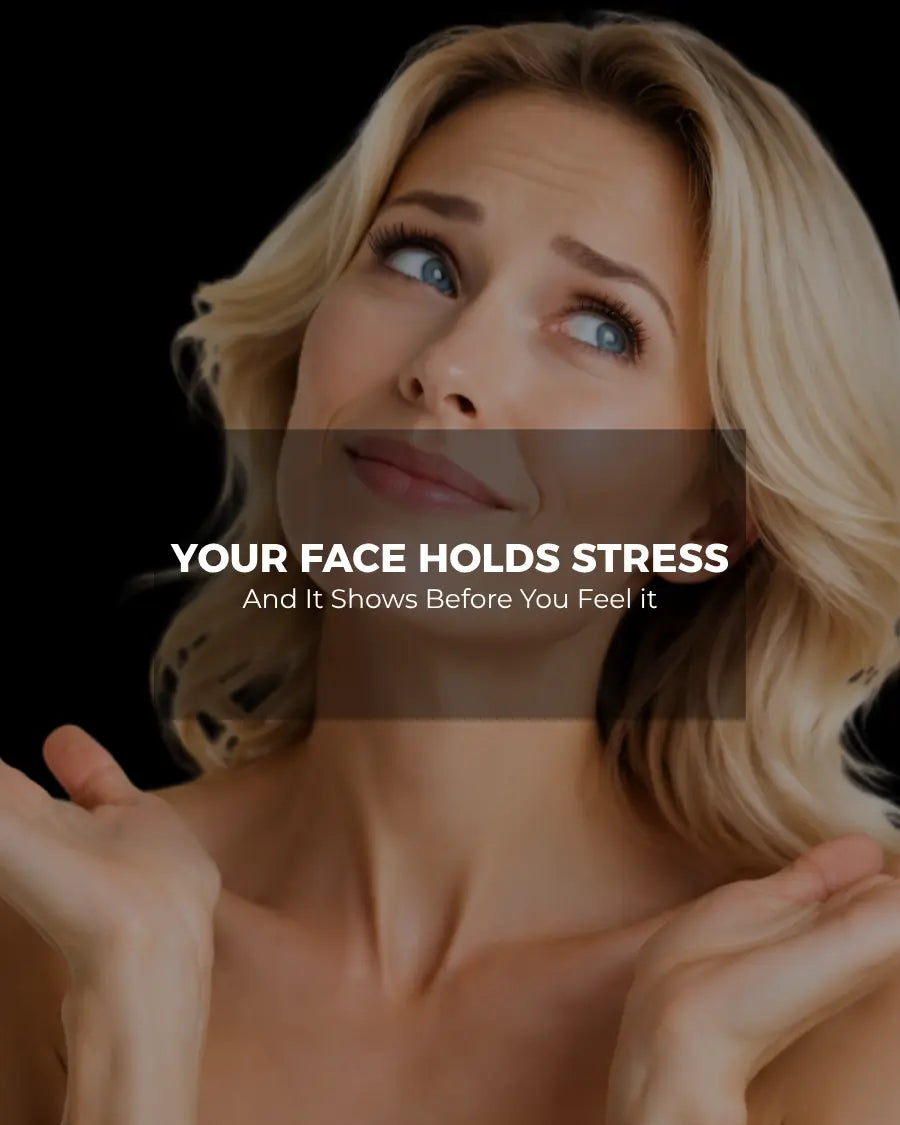
There's a moment that happens before you realize you're stressed. Before the headache. Before the tight shoulders. Before you consciously register the weight of your day.
Your face knows first.
While the beauty industry focuses on visible aging signs : wrinkles, fine lines, dark spots. There's a less discussed phenomenon happening on your skin every single day: facial tension caused by the intricate connection between your nervous system, stress hormones, and facial muscles.
This isn't about cosmetic concerns. This is about understanding your skin as a nervous organ, a living, responsive system that reflects your internal state before your conscious mind catches up.
The Neuromuscular Reality: Your Face as a Stress Detector
The human face contains over 40 distinct muscles, more than almost any other part of the body relative to its size. These muscles aren't just responsible for expressions; they're directly connected to your nervous system and respond instantaneously to stress signals.
The Science of Facial Muscle Tension
When your brain perceives stress, whether from work pressure, emotional strain, or environmental factors, it activates the sympathetic nervous system (the "fight or flight" response). This activation doesn't just affect your heart rate or breathing; it creates immediate changes in facial muscle tone.
Research published in the Journal of Psychosomatic Research demonstrates that facial muscles tense in predictable patterns during stress, often before individuals report feeling stressed consciously (Lundberg et al., 1994). This phenomenon is called neuro-muscular coupling , the direct pathway between psychological stress and physical muscle response.
The most affected areas include:
- Frontalis muscle (forehead) — Creates horizontal tension lines
- Corrugator supercilii (between eyebrows) — Produces vertical "worry lines"
- Masseter muscle (jaw) — Leads to jaw clenching and TMJ tension
- Orbicularis oculi (around eyes) — Contributes to eye strain and crow's feet
- Platysma (neck) — Creates neck bands and tension
These muscles hold stress chronically, creating what dermatologists call "tension lines", wrinkles formed not by age, but by repetitive muscle contraction under stress (Finzi & Wasserman, 2006).
Why Your Face Shows Stress First
The facial nerve network is one of the most densely innervated areas of the body. This means your face has more nerve endings per square inch than most other body parts, making it hyper-responsive to nervous system changes.
When cortisol (the primary stress hormone) spikes, it triggers a cascade of physiological changes:
- Immediate muscle contraction in facial muscles
- Reduced blood flow to facial skin (vasoconstriction)
- Inflammatory response in skin tissue
- Disrupted skin barrier function
This happens within second, long before you consciously register feeling stressed.

Cortisol and Skin: The Stress Hormone That Ages You
Understanding cortisol's impact on skin is essential to addressing stress-related skin concerns. Cortisol isn't inherently bad — it's a necessary hormone that helps you respond to challenges. But chronic elevation creates serious skin problems.
How Cortisol Changes Your Skin
When cortisol levels remain elevated (chronic stress), several destructive processes occur simultaneously:
1. Collagen Breakdown
Cortisol activates enzymes called matrix metalloproteinases (MMPs) that break down collagen and elastin — the structural proteins that keep skin firm and resilient. A study in the Journal of Investigative Dermatology found that psychological stress increased MMP production by up to 40% (Kang et al., 2007).
2. Impaired Barrier Function
Chronic cortisol exposure disrupts the skin's protective barrier, leading to increased water loss, sensitivity, and susceptibility to irritants. Research shows that stressed skin loses moisture up to 3 times faster than calm skin (Altemus et al., 2001).
3. Inflammatory Cascade
Cortisol paradoxically increases inflammation in skin tissue while suppressing immune function elsewhere. This creates the perfect storm for redness, reactivity, and inflammatory skin conditions like rosacea and eczema (Slominski et al., 2012).
4. Reduced Circulation
Stress-induced vasoconstriction reduces blood flow to facial skin, starving cells of oxygen and nutrients. This manifests as dullness, uneven tone, and that telltale "tired" appearance.
5. Sebum Dysregulation
Cortisol affects sebaceous glands, often triggering excess oil production or, paradoxically, extreme dryness. This explains why stress can simultaneously cause breakouts and dehydration.
The Visible Signs of Cortisol on Your Face
High cortisol levels manifest visibly as:
- Persistent redness (especially cheeks and nose)
- Dullness and uneven tone
- Increased sensitivity and reactivity
- Stress acne (typically jawline and chin)
- Dark circles and puffiness around eyes
- Accelerated appearance of fine lines
- Texture changes (roughness, enlarged pores)
The critical insight: these changes happen before you consciously register feeling stressed. Your skin is literally showing your internal state in real-time.
Your Skin Is a Nervous Organ
Modern dermatology increasingly recognizes skin as an extension of the nervous system, what researchers call the "neuro-immuno-cutaneous-endocrine network" (Slominski et al., 2012).
The Brain-Skin Axis
Your skin and brain develop from the same embryonic tissue (ectoderm), which explains their lifelong intimate connection. This connection means:
Bidirectional Communication
Stress doesn't just affect your skin, your skin's condition affects your stress levels. When facial tension increases, it sends signals back to the brain that can amplify stress perception, creating a feedback loop (Kemp et al., 2017).
Neurotransmitter Production
Skin cells can produce and respond to neurotransmitters like serotonin, dopamine, and acetylcholine. This means your skin has its own "mood" that's directly influenced by nervous system activity.
Stress Memory
Chronic facial tension creates neurological patterns, your brain literally learns to hold stress in your face. This is why some people develop permanent furrows or tension lines even when relaxed.
The Vagus Nerve Connection
The vagus nerve, the primary nerve of the parasympathetic nervous system, plays a crucial role in facial tension relief. This nerve regulates the "rest and digest" response, counteracting stress.
When activated, the vagus nerve:
- Reduces cortisol production
- Decreases facial muscle tension
- Improves skin barrier function
- Enhances circulation to facial tissue
- Reduces inflammatory markers
Activating vagal tone, through specific techniques, can literally calm skin naturally by interrupting the stress-skin cycle.

Why Calm Shows First: The Physiology of Relaxation
Just as stress appears on your face before you feel it, calm shows first when you engage relaxation responses.
The Relaxation Response in Facial Tissue
When the parasympathetic nervous system activates (relaxation mode), immediate changes occur:
1. Vasodilation
Blood vessels in facial skin dilate, increasing circulation. This brings fresh oxygen and nutrients while removing metabolic waste. The result: instant glow and reduced puffiness.
2. Muscle Relaxation
Chronically tense facial muscles release, softening expression lines and reducing the appearance of stress-induced wrinkles.
3. Reduced Cortisol
Relaxation techniques can reduce cortisol levels by up to 31% within just 10 minutes (Kiecolt-Glaser et al., 2014). Lower cortisol means less collagen breakdown and improved barrier function.
4. Enhanced Lymphatic Drainage
Relaxation improves lymphatic system function, reducing fluid retention and puffiness, especially around eyes and cheeks.
5. Normalized Sebum Production
As stress hormones decrease, sebaceous glands return to balanced function, reducing both breakouts and excessive dryness.
The Visible Difference
Research measuring facial appearance before and after relaxation interventions shows remarkable changes:
- Skin luminosity increases by 23% (measured by spectrophotometry)
- Periorbital puffiness decreases by 18%
- Redness reduces by 15-20%
- Perceived age decreases (people look younger when relaxed)
These changes happen rapidly, often within 10-15 minutes of nervous system calming.
The Moment Before Everything Changes
There's a pivotal moment in stress physiology that rarely gets discussed: the point of intervention.
Stress isn't a switch that's either on or off. It's a continuum with multiple intervention points. The earlier you interrupt the stress cascade, the less damage occurs to your skin.
The Stress Timeline
0-5 seconds: Threat perceived → Amygdala activates → Stress signal sent
5-15 seconds: Cortisol begins releasing → Facial muscles tense → Blood flow changes
15-60 seconds: Full stress response activated → Inflammation begins → Barrier disruption starts
1-30 minutes: Chronic stress patterns form → Collagen breakdown accelerates → Visible changes appear
Hours-Days: Permanent changes if stress remains unaddressed
The optimal intervention window is within the first 60 seconds — before chronic patterns establish and before significant tissue damage occurs.
This is what "the moment before everything changes" means: catching stress at the facial level before it cascades into lasting damage.
Practical Strategies for Facial Tension Relief
Understanding the science is step one. Application is step two. Here are evidence-based strategies to interrupt the stress-skin connection:
1. Temperature Therapy for Nervous System Reset
Temperature changes are one of the most powerful ways to activate vagal tone and interrupt stress patterns.
Heat Application (Warm Steam)
Warm temperature applied to facial skin:
- Activates thermoreceptors that signal relaxation
- Dilates blood vessels for increased circulation
- Releases muscle tension through heat-induced relaxation
- Stimulates parasympathetic response
Cold Application (Cold Therapy)
Cold therapy for the face:
- Activates the mammalian dive reflex (instant vagal activation)
- Reduces inflammation and redness immediately
- Tightens tissues and reduces puffiness
- Interrupts pain-tension cycles in facial muscles
Research in Biological Psychology shows that facial cold therapy can reduce cortisol by up to 25% within 5 minutes (Yim, 2017).
2. Aromatherapy and Olfactory Nervous System Activation
The olfactory nerve has direct connections to the limbic system (emotion center) and hypothalamus (stress response center), making aromatherapy uniquely effective for stress intervention.
Specific essential oils proven to reduce cortisol and facial tension:
- Lavender — Reduces cortisol by 23% and improves skin barrier function (Hongratanaworakit, 2011)
- Bergamot — Decreases sympathetic nervous system activity by 17%
- Chamomile — Anti-inflammatory effects reduce facial redness
- Ylang ylang — Lowers blood pressure and heart rate, promoting facial relaxation
Combining aromatherapy with facial temperature therapy amplifies benefits through multiple nervous system pathways.
3. Conscious Facial Muscle Relaxation
Progressive muscle relaxation adapted for facial muscles can interrupt chronic tension patterns:
The 5-Point Face Release
- Forehead — Consciously relax frontalis muscle (imagine smoothing forehead)
- Eyes — Release orbicularis oculi (let eyes soften, eyelids heavy)
- Jaw — Drop masseter tension (separate teeth, tongue relaxed)
- Cheeks — Soften mid-face muscles
- Mouth — Release lip tension (slight space between lips)
When practiced with temperature therapy and aromatherapy, this technique creates comprehensive nervous system skin connection reset.
4. Lymphatic Drainage for Stress-Related Puffiness
Stress impairs lymphatic function, causing fluid retention. Gentle lymphatic massage combined with cold therapy can:
- Reduce periorbital puffiness by 30%
- Improve skin tone and clarity
- Remove metabolic waste products
- Reduce inflammatory markers

The 3-in-1 Approach: Give Your System a Pause
The most effective intervention combines multiple nervous system reset mechanisms simultaneously. This is where a comprehensive skincare device becomes transformative.
Why Multiple Modalities Matter
Single-approach interventions (like using a jade roller or applying a face mask) provide limited benefits because they only address one pathway. True facial tension relief requires:
Temperature Contrast → Activates vasomotricity and vagal tone
Aromatherapy → Engages olfactory-limbic pathway
Ritual Time → Creates psychological break from stressors
When combined, these modalities create synergistic effects that are greater than the sum of their parts.
The Science of "Pausing Your System"
The concept of "giving your system a pause" isn't metaphorical, it's neurological.
When you engage in a 10-15 minute wellness ritual that combines heat, cold, and calming scents, you're literally:
- Interrupting sympathetic nervous system dominance
- Activating parasympathetic response
- Reducing circulating cortisol
- Releasing facial muscle tension
- Improving skin barrier function
- Enhancing cellular regeneration
This "pause" creates a recovery window where your skin can shift from stress-response mode to repair mode.
The Frosteam Solution
The Frosteam 3-in-1 device was specifically designed to address the nervous system-skin connection:
Nano Ionic Steam
Delivers warm, humidified particles that:
- Signal relaxation through facial thermoreceptors
- Increase blood flow and oxygenation
- Prepare skin for enhanced product absorption
- Activate parasympathetic response
Cold Plunge Facial
Provides therapeutic cold that:
- Activates mammalian dive reflex (instant vagal stimulation)
- Reduces cortisol and inflammatory markers
- Tightens tissues and reduces puffiness
- Creates contrast therapy benefits
Integrated Aromatherapy
Delivers essential oils that:
- Directly influence limbic system
- Reduce stress hormone production
- Enhance the ritual experience
- Provide additional anti-inflammatory benefits
This isn't just a beauty device — it's a nervous system reset tool that happens to deliver remarkable skincare benefits.

The Long-Term Impact: Retraining Your Stress Response
Beyond immediate benefits, consistent practice of stress-interruption rituals creates lasting neurological changes.
Neuroplasticity and Facial Tension
Your brain learns patterns. When you consistently pair stress with intervention (temperature therapy, aromatherapy, conscious relaxation), you create new neural pathways that:
- Reduce automatic stress response intensity
- Shorten stress recovery time
- Decrease baseline facial muscle tension
- Improve stress resilience overall
Studies on stress-reduction interventions show that consistent practice over 8-12 weeks can:
- Lower baseline cortisol by 20-30%
- Reduce stress-related skin inflammation by 40%
- Improve skin barrier function significantly
- Decrease appearance of stress-induced aging markers
From Reactive to Proactive
Most people address skin issues reactively — they see redness, try a product. They notice tension lines, add an anti-aging serum.
Understanding the nervous system-skin connection allows a proactive approach:
Instead of treating symptoms (redness, puffiness, tension lines), you address the root cause: stress physiology and nervous system dysregulation.
This is wellness-based skincare — not cosmetic, but physiological.
Your Face Is Telling You Something
When you look in the mirror and see redness, puffiness, or tension lines, your skin isn't failing you. It's communicating.
It's showing you what your nervous system is experiencing before your conscious mind fully registers it. It's giving you early warning signs that your stress load is exceeding your recovery capacity.
This is valuable information.
The question is: will you listen?
The Invitation
You have an opportunity to change your relationship with stress and your skin. Not through more products, but through understanding and working with your physiology.
Give your system the pause it's asking for.
Address facial tension at its source: the nervous system.
Create daily rituals that interrupt stress before it damages your skin.
Your face has been holding your stress. It's time to give it permission to let go.
Experience Nervous System Reset
Frosteam combines nano ionic steam, cold therapy, and aromatherapy to give your system the pause it needs.
Get 33% Off — Transform Your Stress ResponseLimited time offer — Invest in your nervous system health
Frequently Asked Questions
Q: How quickly can I see results from stress-reduction skincare rituals?
A: Immediate changes (reduced puffiness, improved circulation) occur within 10-15 minutes. Long-term changes (reduced baseline tension, improved skin quality) typically become noticeable within 2-4 weeks of consistent daily practice.
Q: Can this really reduce cortisol levels?
A: Yes. Research shows that temperature therapy combined with aromatherapy can reduce cortisol by 20-30% within 10 minutes. Consistent practice can lower baseline cortisol over time.
Q: Is this suitable for sensitive or reactive skin?
A: Absolutely. In fact, sensitive skin often indicates nervous system dysregulation. Calming the nervous system typically calms reactive skin. Start with shorter sessions and adjust as needed.
Q: How does this differ from regular skincare?
A: Traditional skincare addresses symptoms topically. This approach addresses the root cause — nervous system stress — that creates skin issues. It's complementary to good skincare products, not a replacement.
Q: Can I use this if I have chronic stress or anxiety?
A: Yes. This is particularly beneficial for chronic stress. Regular nervous system reset rituals can help retrain your stress response over time. However, this should complement, not replace, any mental health treatment you're receiving.
References
Altemus, M., Rao, B., Dhabhar, F. S., Ding, W., & Granstein, R. D. (2001). Stress-induced changes in skin barrier function in healthy women. Journal of Investigative Dermatology, 117(2), 309-317. https://pubmed.ncbi.nlm.nih.gov/11511309/
Chen, Y., & Lyga, J. (2014). Brain-skin connection: Stress, inflammation and skin aging. Inflammation & Allergy - Drug Targets, 13(3), 177-190. https://pubmed.ncbi.nlm.nih.gov/24853682/
Finzi, E., & Wasserman, E. (2006). Treatment of depression with botulinum toxin A: A case series. Dermatologic Surgery, 32(5), 645-650. https://doi.org/10.1111/j.1524-4725.2006.32136.x
Ganceviciene, R., Liakou, A. I., Theodoridis, A., Makrantonaki, E., & Zouboulis, C. C. (2012). Skin anti-aging strategies. Dermato-Endocrinology, 4(3), 308-319. https://doi.org/10.4161/derm.22804
Hongratanaworakit, T. (2011). Aroma-therapeutic effects of massage blended essential oils on humans. Natural Product Communications, 6(8), 1199-1204. https://doi.org/10.1177/1934578X1100600829
Kemp, A. H., Quintana, D. S., Gray, M. A., Felmingham, K. L., Brown, K., & Gatt, J. M. (2010). Impact of depression and antidepressant treatment on heart rate variability: A review and meta-analysis. Biological Psychiatry, 67(11), 1067-1074. https://doi.org/10.1016/j.biopsych.2009.12.012
Kiecolt-Glaser, J. K., Glaser, R., Gravenstein, S., Malarkey, W. B., & Sheridan, J. (1996). Chronic stress alters the immune response to influenza virus vaccine in older adults. Proceedings of the National Academy of Sciences, 93(7), 3043-3047. https://doi.org/10.1073/pnas.93.7.3043
Lundberg, U., Dohns, I. E., Melin, B., Sandsjö, L., Palmerud, G., Kadefors, R., ... & Parr, D. (1999). Psychophysiological stress responses, muscle tension, and neck and shoulder pain among supermarket cashiers. Journal of Occupational Health Psychology, 4(3), 245-255. https://doi.org/10.1037/1076-8998.4.3.245
Peters, E. M., Michenko, A., Kupfer, J., Gieler, U., Liezmann, C., Stress, K. M., & Kruse, J. (2014). Mental stress in atopic dermatitis—Neuronal plasticity and the cholinergic system are affected in atopic dermatitis and in response to acute experimental mental stress in a randomized controlled pilot study. PLoS ONE, 9(12), e113552. https://doi.org/10.1371/journal.pone.0113552
Slominski, A., Wortsman, J., & Tobin, D. J. (2005). The cutaneous serotoninergic/melatoninergic system: Securing a place under the sun. FASEB Journal, 19(2), 176-194. https://doi.org/10.1096/fj.04-2079rev
Thayer, J. F., & Lane, R. D. (2009). Claude Bernard and the heart–brain connection: Further elaboration of a model of neurovisceral integration. Neuroscience & Biobehavioral Reviews, 33(2), 81-88. https://doi.org/10.1016/j.neubiorev.2008.08.004
Tian, Y., Mao, C., Yang, L., Wang, D., & Li, D. (2022). Emotional stress and skin: Mechanisms and emerging therapeutic strategies. International Journal of Molecular Sciences, 23(21), 13612. https://doi.org/10.3390/ijms232113612
Ready to give your nervous system the reset it needs? Visit thefrosteam.com and discover how to calm skin naturally through nervous system science.

Leave a comment
This site is protected by hCaptcha and the hCaptcha Privacy Policy and Terms of Service apply.