



Face Icing vs Face Plunge: Which Cold Therapy Trend Is Better for Your Skin
Compare face icing and the face plunge—benefits, risks, and why Frosteam’s 3-in-1 device makes cold therapy safe and effortless.

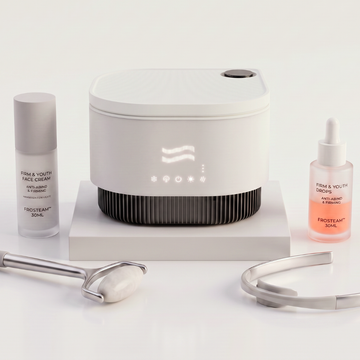
When it comes to face icing vs face plunge, both promise tighter pores and a glowing complexion — but one method clearly comes out ahead. While face icing can reduce puffiness, it often causes uneven temperatures, irritation, and even broken capillaries when overused. The face plunge, on the other hand, offers more consistent cooling and deeper benefits for circulation, elasticity, and long-term skin health. Frosteam™ takes this further, delivering a perfectly controlled cold therapy that enhances collagen production, firms the skin, and achieves that post-facial glow — without the risks of ice cubes.
Updated July 2026
Quick verdict: face plunge wins for full-face results
A face plunge cools every zone of the face evenly and triggers the mammalian dive reflex — an instant nervous-system calming response that ice cubes can't reproduce. Face icing remains useful for spot-treating puffiness, but uneven temperatures and ice-burn risk make it hard to sustain daily. A temperature-controlled cold plunge (1–4 °C / 34–39 °F) delivers the plunge's benefits without the ice, the mess, or the guesswork.
This guide compares both methods, their pros and cons, and shows how the Frosteam 3-in-1 device elevates cold therapy into a smart, daily ritual.
What Is Face Icing?
Face icing means applying ice cubes or frozen tools (rollers, globes, spoons) directly to the skin. Curious why face icing works in the first place? We break down the full mechanism in our guide.
- How it works: Cold constricts blood vessels to reduce puffiness; when skin re-warms, circulation rebounds for an immediate glow.
- Benefits: Quick depuffing, short-term pore-tightening, soothing after workouts or heat.
- Drawbacks: Risk of ice burns/irritation, inconsistent temperature, messy to use daily.

What Is a Face Plunge?
The face plunge immerses your face in a bowl of icy water for a few seconds—often repeated in short intervals.
- How it works: A brief full-face cold shock triggers the mammalian dive reflex, calming the nervous system and reducing inflammation.
- Benefits: Fast, all-over depuffing; invigorating reset for skin and mood.
- Drawbacks: Requires setup (bowl + lots of ice), uncomfortable for sensitive skin, tough to maintain consistently.

Face Icing vs Face Plunge: Side-by-Side
| Criteria | Face Icing | Face Plunge |
|---|---|---|
| Convenience | Easy tools, but messy; uneven cold | More setup (bowl + ice); time-consuming |
| Coverage | Localized areas | Full-face impact |
| Nervous-system effect | Minimal (localized contact) | Triggers the dive reflex (vagal calming) |
| Risks | Ice burns, broken capillaries if overused | Redness, discomfort; harsh for sensitive skin |
| Sustainability | Hard to keep daily | Rarely sustainable long-term |
Meet Frosteam: Cold Therapy, Evolved
Skip the ice cubes and bowls. Frosteam delivers safe, precise cold therapy—no burns, no mess, plus two additional benefits for a complete ritual.
- Precision Cold Plunge (1–4 °C): A temperature-controlled facial cold-water basin for fast depuffing and pore-tightening, gentle enough for daily use.
- Nano-Ionic Steam: Deep hydration and pore prep before serums.
- Aromatherapy: Relaxing sensory boost to de-stress your routine.

60-Second Frosteam Cold Ritual
- Start with nano-ionic steam (30–60s) to soften and hydrate.
- Apply your serum.
- Finish with the cold plunge (6 quick dips of 10–15 seconds) to calm, depuff, and lock in glow.
Key Takeaways
- Face icing and the face plunge can deliver short-term results, but are inconsistent and harder on skin.
- Frosteam offers controlled cold plus steam and aromatherapy for spa-level results—safely, every day.
FAQ
Is cold therapy safe for sensitive skin?
Direct ice can irritate sensitive skin. Frosteam’s controlled cold plunge (1–4 °C) is designed for gentle, repeatable use. Always start with short sessions.
Can I combine steam and cold in one routine?
Yes. Steam preps and hydrates; cold finishes by calming and tightening—this pairing helps serums perform better.
How often should I use cold therapy?
Most people benefit from brief daily use or 3–4 times per week. Adjust based on how your skin feels.


Leave a comment
This site is protected by hCaptcha and the hCaptcha Privacy Policy and Terms of Service apply.