


Article: Sebaceous Filaments vs Blackheads: How to Tell the Difference
Sebaceous Filaments vs Blackheads: How to Tell the Difference
Not every dark dot on your nose is a blackhead. How to tell sebaceous filaments from blackheads in a mirror, why the difference changes what you should do, and what to stop doing to your nose.

Sebaceous filaments and blackheads look alike at first glance, but they are not the same thing. Sebaceous filaments are a normal part of how oil travels through your pores: small, flat, evenly spaced, greyish or beige dots, usually across the nose. Blackheads are clogged pores: fewer, larger, darker and more scattered. The difference matters because filaments are not something to clear, while blackheads respond to a consistent routine.
What are sebaceous filaments?
Every pore on your face is connected to a sebaceous gland, which produces sebum, the oil that keeps skin supple. Sebaceous filaments are the thin columns of sebum and shed skin cells that line the pore on its way out. Dermatologists describe them as a mix of sebum and cornified skin cells around the hair follicle, most visible in the oiliest areas of the face.
In other words, they are not a sign of dirty skin or of a problem. They are part of normal skin anatomy. Some people simply see them more than others, usually those with oilier skin or more visible pores on the nose, chin and inner cheeks.
What are blackheads?
A blackhead is a pore that has become clogged with excess oil, dead skin cells and bacteria, and has stayed open at the surface. According to the American Academy of Dermatology, the dark colour is not dirt: it is the clogged material darkening where it meets the air. A whitehead is the same clog with the pore closed over it.
Blackheads are a mild form of acne, technically called open comedones. They can appear anywhere oil production is high, and they tend to come and go with oil levels, products and habits.
Sebaceous filaments vs blackheads: how do you tell the difference?
Use good daylight and a mirror, and look at the pattern rather than a single dot.

| Sebaceous filaments | Blackheads | |
|---|---|---|
| Colour | Grey, beige or light yellow | Dark brown to black |
| Size | Tiny, pinpoint, all roughly the same size | Larger, and varying in size |
| Pattern | Evenly spaced, in a regular grid | Scattered and irregular |
| Texture | Flat, you cannot feel them | Can feel slightly raised or rough |
| Where | Mostly the nose, then chin and inner cheeks | Nose, chin, forehead, sometimes cheeks and back |
| What they are | A normal part of the pore | A clogged pore, a mild form of acne |
A quick rule of thumb: if every pore on your nose has the same faint dot, you are almost certainly looking at sebaceous filaments. If you see a handful of distinctly darker, bigger dots among clear pores, those are more likely blackheads. Many people have both.
Should you squeeze sebaceous filaments?
No. Squeezing pushes out the column of sebum, and the pore looks clearer for a short while, but the filament forms again because it is part of how the pore works. In the meantime, pressing and pinching can irritate the skin. The American Academy of Dermatology notes that picking or squeezing can make pores look more prominent, not less.
The same goes for pore strips used several times a week. They lift the top of the filament, which feels satisfying, and the filament returns. If you use them, keep them occasional.
What actually helps with sebaceous filaments?
You cannot remove them, and you do not need to. You can make them less visible.
- Cleanse twice a day, gently. Warm, not hot, water and a non-comedogenic cleanser, without scrubbing.
- Use non-comedogenic products. Look for labels such as “oil free” or “won't clog pores” on moisturizer, sunscreen and makeup.
- Consider a salicylic acid cleanser. The AAD notes it may help unclog pores. If it dries your skin, alternate it with a mild cleanser and use it in the evening.
- Wear sunscreen daily. Sun damage reduces skin firmness over time, which can make pores look larger.
And what helps with blackheads?
Blackheads respond to a routine, given enough time. The American Academy of Dermatology recommends a retinoid to help unclog pores, and adapalene is available without a prescription. A benzoyl peroxide wash can also be part of the routine. Give any approach six to eight weeks before judging it, and do not scrub: the dark tip is not dirt, and scrubbing tends to irritate rather than clear.
If blackheads persist after that, a dermatologist can offer professional extraction or prescription-strength options. We cover the full at-home approach in how to get rid of blackheads at home, and the nose specifically in why blackheads on your nose keep coming back.
Does steaming help with sebaceous filaments or blackheads?
Steam softens the skin's surface and leaves it feeling cleaner and more supple, which is why it is a classic step before a mask or a treatment. It does not clear pores on its own, and it is not a reason to squeeze afterwards. Think of steam as preparation, not extraction. If you want to understand what warm mist actually does, start with nano-ionic steam facial benefits.
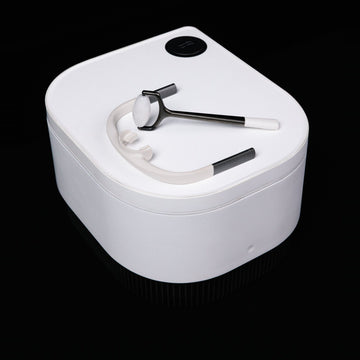
A short cold phase after steam is the natural counterpart: it can leave skin looking temporarily tighter and pores looking less noticeable. That warm-then-cold sequence is the ritual Frosteam Harmony was designed around, with nano-ionic steam, a facial cold plunge held between 1 and 4°C and a built-in waterless aroma diffuser in one device. Get Yours Now.
Where these steps fit in your day is covered in skincare routine order: what goes first. And if you are still unsure what your skin needs, take our free AI Skin Analysis.
Sources
- American Academy of Dermatology Association. How to treat different types of acne.
- American Academy of Dermatology Association. What can treat large facial pores?
- Mineroff JP, Hyde JT, Hsu S. A case report of sebaceous filaments. Cureus. 2023;15(11):e48656.
Watch the ritual
The contrast therapy facial ritual, step by step
The complete ritual in under a minute: nano-ionic steam, a facial cold plunge and aromatherapy, step by step.



Leave a comment
This site is protected by hCaptcha and the hCaptcha Privacy Policy and Terms of Service apply.