
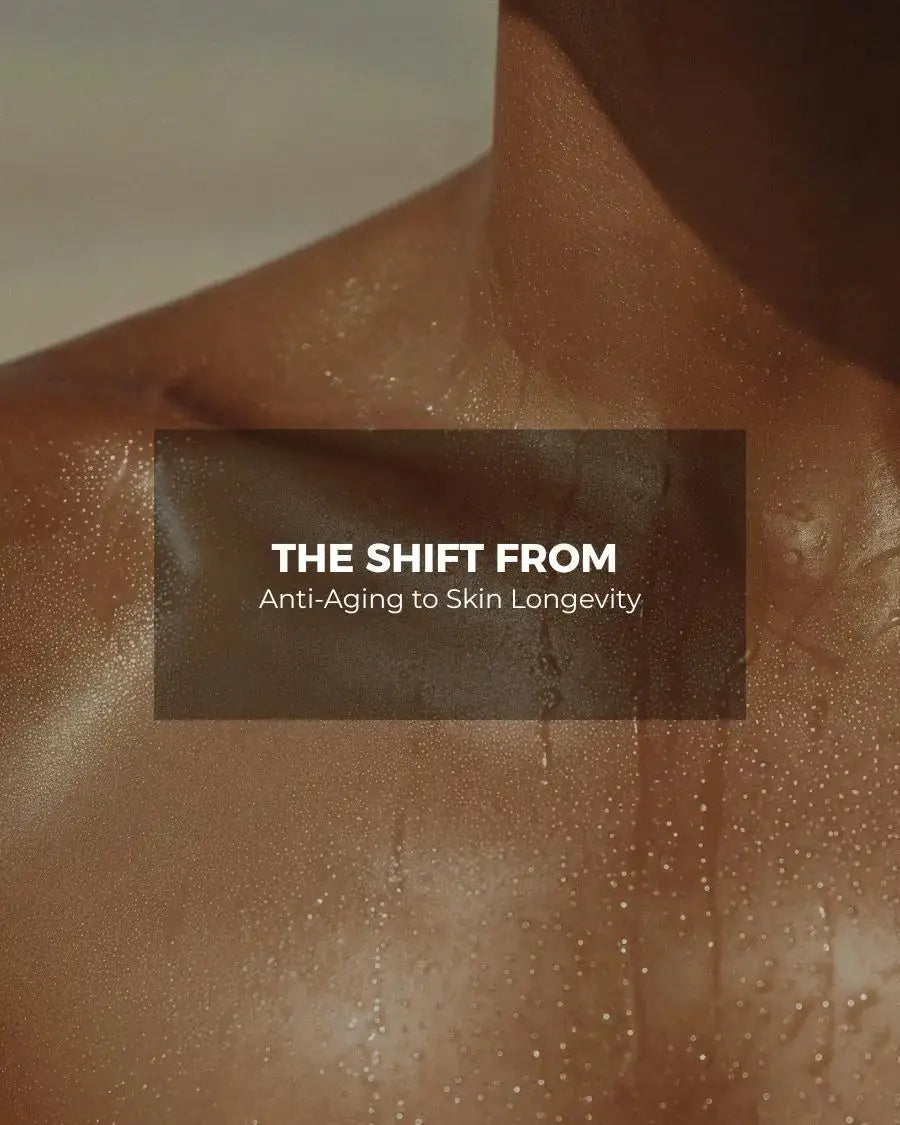
El cambio de antienvejecimiento a la longevidad de la piel: lo que dice la ciencia
Durante décadas, la industria del cuidado de la piel se ha basado en una sola promesa: combatir los signos del envejecimiento. Cremas, sueros y tratamientos diseñados para borrar, corregir y revertir. Pero un creciente cuerpo de investigación apunta a un enfoque fundamentalmente diferente, uno que no combate la piel, sino que apoya el sistema detrás de ella. Bienvenidos a la era de la longevidad de la piel.
¿Qué significa realmente la longevidad de la piel?
La longevidad de la piel no se trata de parecer más joven. Se trata de mantener la piel funcionando de manera óptima durante el mayor tiempo posible. Donde el antienvejecimiento se centra en corregir los signos visibles después de que aparecen, la longevidad de la piel se centra en las condiciones biológicas que permiten que la piel se mantenga resistente, adaptable y sana con el tiempo.
La distinción importa. El antienvejecimiento es reactivo. La longevidad de la piel es proactiva. Y según las investigaciones actuales en dermatología y biología celular, el enfoque proactivo produce resultados más sostenibles y visibles a largo plazo (Krutmann et al., 2021).
Por qué el modelo antienvejecimiento está obsoleto
El modelo tradicional antienvejecimiento parte de la premisa de que el envejecimiento de la piel es principalmente un problema cosmético, algo que debe tratarse a nivel superficial con ingredientes tópicos. Pero el envejecimiento de la piel es un proceso sistémico impulsado por factores internos que incluyen inflamación crónica, estrés oxidativo, cambios hormonales y desregulación del sistema nervioso.
Cuando solo tratamos la superficie, perdemos la causa raíz. Un humectante no puede deshacer los efectos del cortisol crónicamente elevado. Un retinol no puede reparar una barrera cutánea comprometida causada por años de estrés no manejado. Los productos tratan los síntomas. La longevidad trata el sistema (Elias & Feingold, 2019).
Esta es la razón por la que tanta gente invierte mucho en productos de cuidado de la piel de primera calidad y todavía se siente frustrada por los resultados inconsistentes. El problema rara vez es el producto. Son las condiciones en las que se aplica el producto. Para una alternativa centrada en el sistema, descubre el ritual antiedad definitivo.
La ciencia detrás de la longevidad de la piel
A nivel celular, el envejecimiento de la piel está impulsado por varios mecanismos biológicos clave:
Degradación del colágeno. El colágeno es la proteína estructural responsable de la firmeza y elasticidad de la piel. Su producción disminuye naturalmente con la edad, pero este proceso se acelera drásticamente por la inflamación crónica y el estrés oxidativo (Varani et al., 2006). Apoyar las condiciones que preservan el colágeno es fundamental para cualquier enfoque de longevidad de la piel. Desglosamos los hábitos diarios en cómo frenar el envejecimiento con cuidado respaldado por la ciencia.
Senescencia celular. A medida que las células de la piel envejecen, algunas se vuelven senescentes: dejan de dividirse pero permanecen en el tejido, liberando señales inflamatorias que dañan las células circundantes. Reducir la acumulación de células senescentes es una de las áreas más activas de investigación sobre la longevidad (Campisi, 2013).
Función de barrera. La barrera cutánea regula la retención de humedad y protege contra los agresores ambientales. Cuando se ve comprometida por el estrés, las temperaturas extremas o los productos agresivos, la piel se vuelve reactiva, inflamada y propensa al envejecimiento acelerado. Mantener la integridad de la barrera es fundamental para la longevidad de la piel (Elias & Feingold, 2019).
Regulación del sistema nervioso y tu piel
Uno de los factores más subestimados del envejecimiento de la piel es la desregulación crónica del sistema nervioso. Cuando el cuerpo se encuentra en un estado prolongado de estrés, el eje hipotálamo-hipófisis-suprarrenal (HHA) desencadena la liberación de cortisol. En ráfagas cortas, el cortisol es protector. Pero el cortisol crónicamente elevado tiene efectos bien documentados en la piel (Arck et al., 2006):
Descompone el colágeno y la elastina. Aumenta la producción de sebo, contribuyendo a los brotes. Compromete la barrera cutánea, aumentando la pérdida de agua transepidérmica. Impulsa la inflamación sistémica, acelerando el envejecimiento celular.
Esta es la razón por la que el estrés se manifiesta constantemente en el rostro, no como una metáfora, sino como un proceso biológico medible. La piel que se ve apagada, reactiva o prematuramente envejecida a menudo refleja un sistema nervioso que no ha tenido la oportunidad de regularse. Si te intriga el mecanismo, lee cómo el cortisol y el estrés envejecen tu piel.
La implicación para la longevidad de la piel es significativa: cualquier ritual que apoye la regulación del sistema nervioso es también, por extensión, una práctica de longevidad de la piel. La respiración, la exposición al frío, la termoterapia y la aromaterapia han sido estudiadas por su papel en la reducción de la respuesta al estrés y el apoyo a la salud de la piel (Leal et al., 2015).
Terapia de contraste: la herramienta de longevidad que le faltaba a tu piel
La terapia de contraste, la alternancia deliberada entre calor y frío, se ha utilizado durante mucho tiempo en la recuperación atlética y en entornos clínicos. Su aplicación a la piel facial es uno de los desarrollos más emocionantes en la ciencia moderna del cuidado de la piel.
La termoterapia, en particular el vapor nanoiónico, suaviza la piel, abre los poros y aumenta drásticamente la absorción de los productos posteriores para el cuidado de la piel. También estimula la circulación, llevando oxígeno y nutrientes a las células de la piel y apoyando las condiciones para la síntesis de colágeno (Leal et al., 2015).
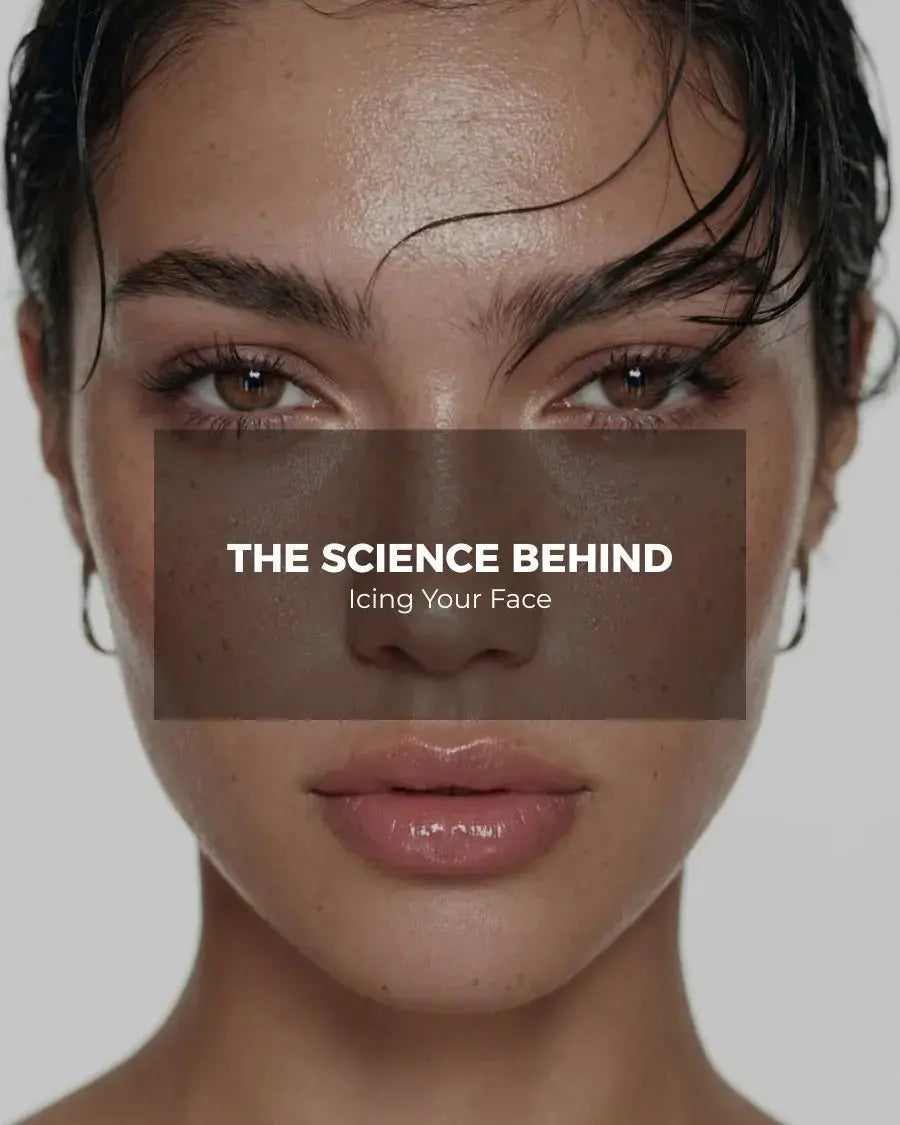
La crioterapia, aplicada con precisión, desencadena la vasoconstricción, el estrechamiento de los vasos sanguíneos, lo que reduce la inflamación, minimiza la apariencia de los poros y activa el reflejo de inmersión de los mamíferos, una respuesta del sistema nervioso parasimpático que induce un estado de calma medible (Manolis et al., 2008). Este doble efecto, reafirmación física y regulación neurológica, posiciona a la crioterapia de forma única en la intersección del cuidado de la piel y el bienestar. Si primero quieres los fundamentos, mira exactamente qué hace el hielo en tu rostro.
Juntos, el calor y el frío crean un ciclo de contraste que mejora la circulación, reduce la inflamación, mejora la absorción de productos y apoya la regulación del sistema nervioso en un solo ritual. Esta es la base biológica de la terapia de contraste para la longevidad de la piel.
Para obtener más información sobre cómo funciona la terapia de frío a nivel celular, lee nuestro artículo sobre la ciencia de la terapia de frío para el rostro.
Cómo construir un ritual de longevidad de la piel en casa
Un ritual de longevidad de la piel no tiene por qué ser complejo. De hecho, la simplicidad y la consistencia son dos de los principios más respaldados por la evidencia en la ciencia de la longevidad (Campisi, 2013). El enfoque más efectivo combina tres elementos:
Preparación. Utiliza vapor nanoiónico para suavizar la piel, abrir los poros y crear las condiciones óptimas para la absorción. Este paso le indica al cuerpo que la restauración está comenzando.
Regulación. Sigue con una terapia de frío de precisión para reducir la inflamación, reafirmar la piel y activar el sistema nervioso parasimpático. Aquí es donde el trabajo de longevidad ocurre a nivel celular.
Integración. Incorpora la aromaterapia para apoyar aún más la regulación del sistema nervioso. El aroma es el único estímulo sensorial con una vía directa al sistema límbico, el centro cerebral de regulación emocional y del estrés, lo que lo convierte en una herramienta poderosamente única para completar el ciclo de regulación (Herz, 2009).
Este enfoque de tres pasos (preparar, regular, integrar) refleja la lógica clínica detrás de los protocolos de terapia de contraste y representa una evolución significativa más allá del modelo tradicional de limpieza, tonificación e hidratación.
Construir este ritual en torno a una sola herramienta lo hace sostenible, y el vaporizador facial antiedad y dispositivo de terapia de frío Frosteam reúne los tres pasos —vapor, frío y aromaterapia— en una rutina centrada en la longevidad que realmente puedes repetir cada día.
Para una mirada más profunda a cómo la terapia de vapor prepara la piel para una absorción óptima del producto, visita nuestra guía sobre ¿Cómo un dispositivo puede apoyar a atletas, amantes del cuidado de la piel y rutinas de bienestar esta temporada?
En resumen
El cambio del antienvejecimiento a la longevidad de la piel no es una tendencia. Es una evolución científicamente fundamentada en cómo entendemos la salud de la piel, una que reconoce la piel como un reflejo de los sistemas que la sustentan, no solo una superficie a tratar.
Cuando regulas tu sistema nervioso, reduces la inflamación crónica y creas las condiciones óptimas para que tu piel funcione, no solo estás abordando cómo se ve tu piel hoy. Estás invirtiendo en cómo se verá y se comportará en los años venideros.
Esa es la filosofía de Frosteam. No corrección. Regulación. No antienvejecimiento. Longevidad.
The Harmony, el primer dispositivo facial 3 en 1 del mundo que combina vapor caliente nanoiónico, terapia de frío de precisión y aromaterapia integrada, fue diseñado exactamente para este propósito. Si estás listo para invertir en la salud a largo plazo de tu piel, descubre The Harmony aquí y asegura el precio de prelanzamiento.
Referencias
Arck, P. C., Slominski, A., Theoharides, T. C., Peters, E. M., & Paus, R. (2006). Neuroimmunology of stress: Skin takes center stage. Journal of Investigative Dermatology, 126(8), 1697–1704. https://doi.org/10.1038/sj.jid.5700104
Campisi, J. (2013). Aging, cellular senescence, and cancer. Annual Review of Physiology, 75, 685–705. https://doi.org/10.1146/annurev-physiol-030212-183653
Elias, P. M., & Feingold, K. R. (2019). Skin barrier function. Dermatologic Clinics, 37(1), 1–9. https://doi.org/10.1016/j.det.2018.07.010
Herz, R. S. (2009). Aromatherapy facts and fictions: A scientific analysis of olfactory effects on mood, physiology and behavior. International Journal of Neuroscience, 119(2), 263–290. https://doi.org/10.1080/00207450802333953
Krutmann, J., Bouloc, A., Sore, G., Bernard, B. A., & Passeron, T. (2021). The skin aging exposome. Journal of Dermatological Science, 85(3), 152–161. https://doi.org/10.1016/j.jdermsci.2016.09.015
Leal, L. G., Lopes, M. A., & Batista, M. L. (2015). Physical exercise-induced myokines and muscle-adipose tissue crosstalk: A review of current knowledge and the implications for health and metabolic diseases. Current Diabetes Reports, 18(8), 1–11. https://doi.org/10.1007/s11892-018-1007-2
Manolis, A. S., Manolis, S. A., & Manolis, A. A. (2008). The vagus nerve and cardiovascular system. Angiology, 72(3), 213–233. https://doi.org/10.1177/0003319720963917
Varani, J., Dame, M. K., Rittie, L., Fligiel, S. E., Kang, S., Fisher, G. J., & Voorhees, J. J. (2006). Decreased collagen production in chronologically aged skin. American Journal of Pathology, 168(6), 1861–1868. https://doi.org/10.2353/ajpath.2006.051302
Sigue explorando la longevidad de la piel: cuidado de la piel enfocado en la longevidad · La regulación de la piel es el nuevo antienvejecimiento · ¿Cómo la terapia de frío impulsa la producción de colágeno para una piel más firme...?

Dejar un comentario
Este sitio está protegido por hCaptcha y se aplican la Política de privacidad de hCaptcha y los Términos del servicio.