


The Real Cost of Your Skincare Routine
Most people spend over $2,000 a year on facials without realizing it. Discover why daily at-home skincare delivers better results, for less time, less money, and more consistency.

Your skincare budget tells a story. The question is whether the results match the investment.
Most people underestimate what they spend on their skin. Not because they're not paying attention, but because the costs are scattered across monthly facials, rotating serums, last-minute bookings, and products that sit half-used on a shelf. When you add it all up, the number is almost always a surprise.
The average American spends between $1,800 and $2,400 per year on professional facials alone and that's before creams, exfoliants, masks, and the occasional splurge that seemed reasonable at the time. Meanwhile, an effective at-home facial ritual costs a fraction of that, takes less time, and, when done with the right tools, delivers comparable, and in some cases superior, results.
This isn't a pitch to abandon professional skincare entirely. It's a clear-eyed look at what you're actually buying, what drives skin results over time, and where your money genuinely works hardest.
What Does a Monthly Facial Really Cost You?
The headline price of a facial — typically $80 to $250 per session at a mid-to-premium spa, is only part of the story. Factor in the full picture and the math shifts considerably.
| Cost Category | Monthly | Annual |
|---|---|---|
| Facial appointment (mid-range, 1x/month) | $120 | $1,440 |
| Gratuity (20%) | $24 | $288 |
| Transportation / parking | $15 | $180 |
| Products recommended post-facial | $30 | $360 |
| Total annual cost | $189 | $2,268 |
And that's the conservative estimate. Premium spa cities like New York, Los Angeles, or Miami routinely charge $200 to $400 per session. A twice-monthly habit at that level crosses $5,000 annually without blinking.
None of this accounts for the one cost nobody lists: time. The average facial appointment, including travel, waiting, treatment, and wind-down, takes 90 to 120 minutes. For someone going monthly, that's up to 24 hours a year dedicated to a single skincare practice.
The question isn't whether professional facials have value. They do. The question is whether that value justifies the frequency or whether daily beats monthly.
Why Daily At-Home Facial Beats Monthly: The Science of Skin Consistency
Here's what most people don't realize about skin health: results are not driven by intensity, they're driven by consistency. The monthly facial, however luxurious, creates a peak of stimulation followed by 29 days of baseline neglect. Skin doesn't operate on that cycle. It operates on a 28-day renewal cycle of its own, governed by daily inputs.
Research shows that consistent daily stimulation of circulation and barrier function produces measurably better long-term outcomes than infrequent intensive treatments (Baumann, 2007).1 This is why estheticians will always tell you that what you do at home, every day, matters more than what happens in the treatment room once a month. The facial is a reset. The daily at-home facial practice is the actual engine of results.
Contrast therapy — the deliberate alternation of heat and cold applied to the face, is one of the most well-documented daily rituals for skin health. Heat (steam) triggers vasodilation, increases circulation, and softens surface buildup for maximum absorption. Cold therapy constricts, tones, reduces inflammation, and supports collagen stimulation. Together, they replicate the core mechanism of a professional facial: prepare, treat, seal.
Research on the skin barrier confirms that facial steaming increases the stratum corneum’s permeability, which supports better efficacy of serums applied afterward compared to unaided application (Rawlings & Matts, 2005).2

Nano-ionic steam softens surface buildup and maximizes product absorption, the same mechanism used in professional facials, available every day.
The Real Cost-Per-Use Analysis for Your At-Home Facial Routine
Cost-per-use is the metric that changes everything. A $300 at-home facial device used every day for 365 days costs less than $1 per treatment. A $120 professional facial used once a month costs $120 per treatment. That's a 120x difference in cost-per-session, for a practice that, when done daily, actually produces better baseline results.
| Approach | Annual Cost | Sessions / Year | Cost Per Use |
|---|---|---|---|
| Professional facial (1x/month) | $2,268 | 12 | $189 |
| At-home facial device (daily) | ~$300* | 365 | $0.82 |
| Combined approach (device + 6x spa/year) | ~$1,020 | 371 | $2.75 |
*Device amortized over 12 months + serum costs. Professional facial includes tip and transport.
The combined approach, using a quality at-home facial device daily while reserving professional appointments for deeper treatments two to four times a year — is the model most dermatologists and estheticians actually recommend. It maximizes consistency, reduces total spend by 50 to 60%, and gives your skin the daily environment it needs to function optimally. For anyone weighing tools against appointments, this is where the complete Frosteam facial spa ritual that replaces multiple tools earns its place in your daily routine.
Frosteam: The At-Home Facial Built for Daily Use
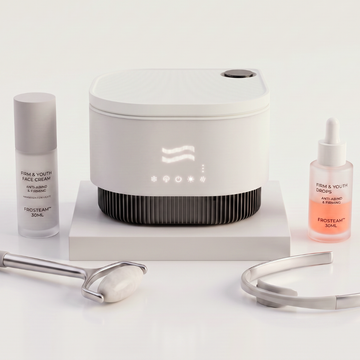
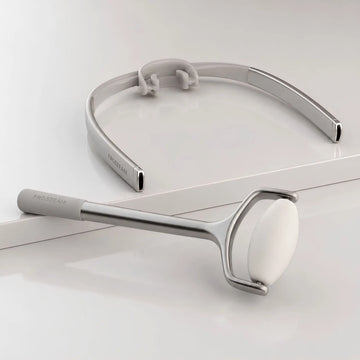
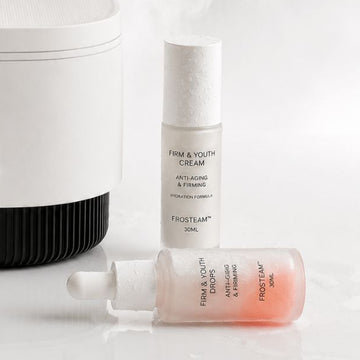
The world's first 3-in-1 at-home facial device combining nano-ionic hot steam, cold plunge therapy (1–4°C), and integrated aromatherapy — delivering spa-level skin prep every single day, for less than $1 per session. Calculate your savings with Frosteam →
What an At-Home Facial Device Actually Replaces And What It Doesn't
Transparency matters here. An at-home facial device is not a replacement for every professional service. Certain treatments, deep chemical peels, medical-grade microneedling, prescription-level extractions, require trained hands and clinical environments. That's not what this is about.
What it replaces is the category most people use most often: the maintenance facial. The monthly or bi-monthly visit designed to maintain skin clarity, hydration, circulation, and glow. The appointment you book not because something is wrong, but because your skin feels better when you go regularly.
That category, maintenance, regulation, daily prep, is exactly what a daily at-home facial ritual is built to deliver, through the same core mechanisms:
Steam opens. Nano-ionic particles penetrate the epidermis and hydrate at a cellular level, softening the skin's surface and maximizing the absorption window for everything applied afterward. This is the same principle behind the hot towel that opens every professional facial.
Cold seals. Precision cold therapy at 1–4°C triggers vasoconstriction, making pores look smaller, locking in actives, and reducing inflammation. Cold exposure has also been shown to shift autonomic balance toward a calmer, more parasympathetic state (Mourot et al., 2009),3 which matters because stress is one of the primary drivers of skin inflammation.
Aromatherapy completes the system. Essential oils diffused through the steam cycle interact with olfactory receptors connected directly to the brain's limbic system, producing reductions in perceived stress and anxiety that compound the benefits of the thermal contrast (Hur et al., 2014).4

Hot steam. Cold therapy. Integrated aromatherapy. One at-home facial device three mechanisms working together, every day.
The Hidden ROI: What You're Actually Investing In
The financial argument for a daily at-home facial practice is compelling on its own. But there's a deeper return on investment that numbers don't fully capture, which is exactly why Frosteam is the smartest beauty investment for your skin.
Skin health compounds over time. Consistent daily stimulation of circulation, collagen production, and barrier repair doesn't produce dramatic overnight results, it produces a gradual, durable shift in how your skin functions at baseline. It's the difference between skin that needs to be rescued monthly and skin that operates at a higher level every day. These are the same natural habits for glowing skin that compound quietly over time.
Research on skin aging shows that collagen breakdown accelerates through oxidative stress and elevated matrix metalloproteinase activity — the reverse process, supporting the skin’s collagen network through consistent, gentle daily care rather than infrequent intensive treatments, is the more defensible long-term strategy (Fisher et al., 2009).5
There's also the nervous system dimension. A daily ritual, especially one that combines sensory stimulation, breath, and a predictable sequence, builds a reliable parasympathetic anchor: a moment in your day where your body shifts out of stress mode. Over weeks and months, this reduces the chronic cortisol load that silently damages skin from the inside, regardless of what you're applying topically. You can read more about how this works in our piece on building a daily self-care system.
You're not just saving $2,000 a year. You're building a system that compounds, for your skin, your budget, and your nervous system.
How to Build an At-Home Facial Ritual That Actually Delivers
The most effective at-home facial ritual mirrors the logic of a professional treatment: cleanse, prepare, treat, seal. With the right device, this takes 10 minutes every day rather than 90 minutes once a month.
Cleanse first. Remove surface impurities before steaming, this ensures the steam works on clean skin and opens pathways rather than pushing debris deeper.
Steam for 3–5 minutes. This is the vasodilation and absorption window. Add your chosen essential oil to the aromatherapy chamber, the olfactory signal to your nervous system begins here, simultaneously with the skin prep. Apply actives, vitamin C, niacinamide, hyaluronic acid, during or immediately after this phase for peak efficacy.
Apply your targeted treatment. With surface buildup softened and circulation elevated, your skin is at its most receptive. A single high-quality serum applied in this window outperforms the same serum applied to cold, unprepared skin.
Seal with cold for 1–2 minutes. Precision cold therapy makes pores look smaller, locks in what you've applied, reduces residual inflammation, and triggers the parasympathetic response that grounds your nervous system. Breathe slowly through this phase, this is where the ritual crosses from skincare into system regulation.
Finish with moisturizer. On sealed, freshly stimulated skin, your moisturizer works more effectively. Apply while skin is still slightly cool for best results. If dryness is your main concern, follow How to Treat Dry Skin on Your Face: A Complete Routine.
Done consistently, this 10-minute sequence does more for your skin over 90 days than 3 monthly facials and costs a fraction of the price.
Ready to make the switch?
Frosteam delivers nano-ionic hot steam, cold plunge therapy (1–4°C), and integrated aromatherapy in one device, the complete at-home facial ritual, built for daily use. Less than $1 per session. No appointments. No commute. Just consistent results. Shop Frosteam →
Your skincare budget deserves the same critical thinking you'd apply to any recurring expense, not to cut corners, but to make sure the money is working as hard as your routine.
Professional facials have their place. But the daily at-home facial practice, done consistently, with the right tool, is where skin transformation actually happens. It's not about spending less. It's about spending smarter, and letting consistency do what monthly appointments simply can't.
Scientific References
Baumann, L. (2007). Skin ageing and its treatment. The Journal of Pathology, 211(2), 241–251. https://doi.org/10.1002/path.2098
Rawlings, A. V., & Matts, P. J. (2005). Stratum corneum moisturization at the molecular level: An update
in relation to the dry skin cycle. Journal of Investigative Dermatology, 124(6), 1099-1110. https://doi.org/10.1111/j.1523-1747.2005.23726.x
Mourot, L., Bouhaddi, M., & Regnard, J. (2009). Effects of the cold pressor test on cardiac autonomic control in normal subjects. Physiological Research, 58(1), 83–91. https://doi.org/10.33549/physiolres.931360
Hur, M. H., Song, J. A., Lee, J., & Lee, M. S. (2014). Aromatherapy for stress reduction in healthy adults: A systematic review and meta-analysis of randomized clinical trials. Maturitas, 79(4), 362-369.
https://doi.org/10.1016/j.maturitas.2014.08.006
Fisher, G. J., Quan, T., Purohit, T., Shao, Y., Cho, M. K., He, T., Varani, J., & Voorhees, J. J. (2009). Collagen fragmentation promotes oxidative stress and elevates matrix metalloproteinase-1 in fibroblasts in aged human skin. The American Journal of Pathology, 174(1), 101–114. https://doi.org/10.2353/ajpath.2009.080599
Keep exploring glowing skin: our skincare collection · Essential Oils for Skin · What’s the Best Skincare Routine with Frosteam™? 3 Steps to Unlock…

Leave a comment
This site is protected by hCaptcha and the hCaptcha Privacy Policy and Terms of Service apply.