



Why Particle Size, Charge & Skin Physiology Matter More Than You Think
Most people think steam is just… steam.
But in skin biology, how water is delivered matters as much as what you apply afterward. Traditional facial steam often creates temporary softness — sometimes followed by redness, dehydration, or rebound sensitivity.
Nano-ionic steam behaves differently.
Not because it is “stronger,” but because it interacts with skin physiology at a different scale — one that respects the skin barrier, inflammation pathways, and hydration mechanisms.
This article explains why nano-ionic steam affects skin differently, without hype, oversimplification, or sales language.

Why All Facial Steam Is Not the Same
Steam can either support skin regulation or disrupt it, depending on three core variables.
1. Particle size
Conventional steam produces large, irregular droplets that condense quickly on the skin surface.
Nano-ionic steam delivers ultra-fine water particles (nanometer scale) that:
- Disperse evenly across the skin
- Remain suspended longer
- Interact with the stratum corneum without pooling
Smaller particles create lower mechanical stress on the skin barrier.
This finer delivery is also why nano-ionic steam penetrates deeper into the skin than conventional steam.
2. Electrical charge (ionic state)
The skin naturally maintains an electrochemical gradient.
Nano-ionic steam particles are electrically charged, which supports:
- Better interaction with surface lipids
- Improved water-binding capacity
- More uniform hydration rather than surface wetting
3. Thermal delivery (controlled heat)
Traditional steam can spike skin temperature rapidly.
Nano-ionic systems are designed to:
- Increase temperature gradually
- Avoid overheating
- Support vasodilation without triggering inflammation
Skin responds best to controlled warmth, not thermal shock.
What Happens at the Skin Barrier Level
The stratum corneum is not “dead skin.” It is a living regulatory interface.
Nano-ionic steam supports this interface by:
- Increasing water content within corneocytes
- Temporarily improving lipid fluidity
- Supporting transepidermal water balance instead of stripping it
Rather than aggressively opening the barrier, nano-ionic steam makes skin more receptive and biologically balanced.

Hydration vs Inflammation: The Critical Difference
Many reactions attributed to “sensitive skin” are actually inflammatory responses to overstimulation.
Scientific research shows that:
- Excessive heat can trigger neurogenic inflammation
- Rapid temperature changes increase barrier stress
- Dehydration amplifies inflammatory signaling
Nano-ionic steam helps reduce these risks by:
- Preventing localized overheating
- Hydrating without occlusion
- Calming the skin before treatment
Calm skin responds better, biologically.
Why Nano-Ionic Steam Improves Product Absorption
Effective absorption does not require forcing the skin open.
Instead, skin needs:
- Proper hydration
- Reduced surface tension
- Temporary lipid flexibility
Nano-ionic steam creates these conditions, allowing skincare products to distribute more evenly and perform more predictably — with less irritation.
This mirrors professional facial logic, not aggressive consumer shortcuts.

Learn more about how steam therapy calms stress and boosts skin hydration.
Where Frosteam Fits Into This Biological Logic
Understanding nano-ionic steam is only part of the picture.
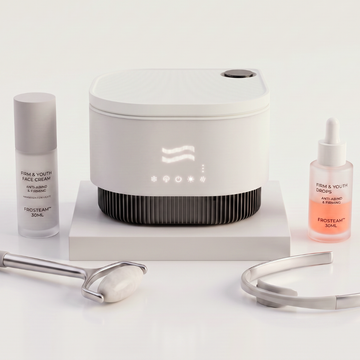
Frosteam was designed around this exact physiological logic: prepare the skin first, regulate it second, then support results.
Rather than relying on a single stimulus, Frosteam integrates:
- Nano-ionic hot steam to hydrate, soften, and increase skin receptivity
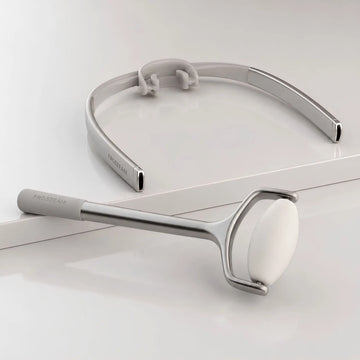
- Cold facial therapy to support vasoconstriction, reduce inflammation, and reinforce the skin barrier
- Aromatherapy diffusion to engage the nervous system and support overall skin calm
This sequence mirrors professional facial protocols, where skin is never treated aggressively in a single step, but guided through a regulated thermal and sensory progression.
Frosteam does not aim to replace skincare products — it creates the optimal biological conditions for them to work consistently.
Nano-Ionic Steam and Skin Regulation
The skin functions as a neuro-immuno-endocrine organ.
When overstimulated, it reacts. When regulated, it performs.
By combining controlled heat, cold exposure, and sensory calming, Frosteam supports:
- Reduced visible stress responses (redness, tightness)
- Improved comfort and skin tolerance
- More predictable skincare results over time
Who Benefits Most From This Approach?
This regulation-first approach is particularly relevant for:
- Reactive or sensitized skin
- Dull, dehydrated winter skin
- Users frustrated by inconsistent results
- People layering active skincare ingredients
- Anyone seeking spa-level skin preparation at home
This is not about intensity — it is about biological intelligence.

Conclusion — From Steam to Skin Intelligence
Nano-ionic steam is not a trend. It represents an evolution in how water, heat, and skin biology interact.
Frosteam applies this science in a structured, intentional way transforming steam from a simple step into a foundation for skin regulation.
When skin is prepared rather than forced, everything that follows works better products, treatments, and long-term results.
Discover more about The Frosteam
Scientific References (APA)
Elias, P. M. (2005). Stratum corneum defensive functions: An integrated view. Journal of Investigative Dermatology, 125(2), 183–200. https://doi.org/10.1111/j.0022-202X.2005.23668.x
Denda, M., & Tsutsumi, M. (2011). Roles of transient receptor potential proteins (TRPs) in epidermal keratinocytes. In M. S. Islam (Ed.), Transient Receptor Potential Channels (Advances in Experimental Medicine and Biology, Vol. 704, pp. 847–860). Springer. https://doi.org/10.1007/978-94-007-0265-3_44
Proksch, E., Brandner, J. M., & Jensen, J. M. (2008). The skin: An indispensable barrier. Experimental Dermatology, 17(12), 1063–1072. https://doi.org/10.1111/j.1600-0625.2008.00786.x
Arck, P. C., Slominski, A., Theoharides, T. C., Peters, E. M. J., & Paus, R. (2006). Neuroimmunology of stress: Skin takes center stage. Journal of Investigative Dermatology, 126(8), 1697–1704. https://doi.org/10.1038/sj.jid.5700104


Leave a comment
This site is protected by hCaptcha and the hCaptcha Privacy Policy and Terms of Service apply.